
The Fedibook project
Fedibook is a Friends First interface into the ActivityPub federated social network — also known as the Fediverse.
Fedibook aims to be the easiest way into the Fediverse, and familiar if you are coming from mainstream social networks like Facebook. That is why we call it Your Friendly Neighborhood Social Network.
Fedibook is for you if you want to connect with friends and community groups. If you want to connect with people all over the world to discuss or learn about your favourite topics, Mastodon is likely the better option. If you want to see and share amazing pictures, go check out Pixelfed. If you are into short videos — whether for building a following or just enjoying a random scroll — go check out Loops.
Want to understand the Fediverse in 4 minutes?- watch the amazing video from Elena Rossini - A true hero of the Fediverse
As you can see there are great alternatives to the shitty applications from Big Tech. I hope for Fedibook to be the last missing alternativ to the Big Shitty Five.
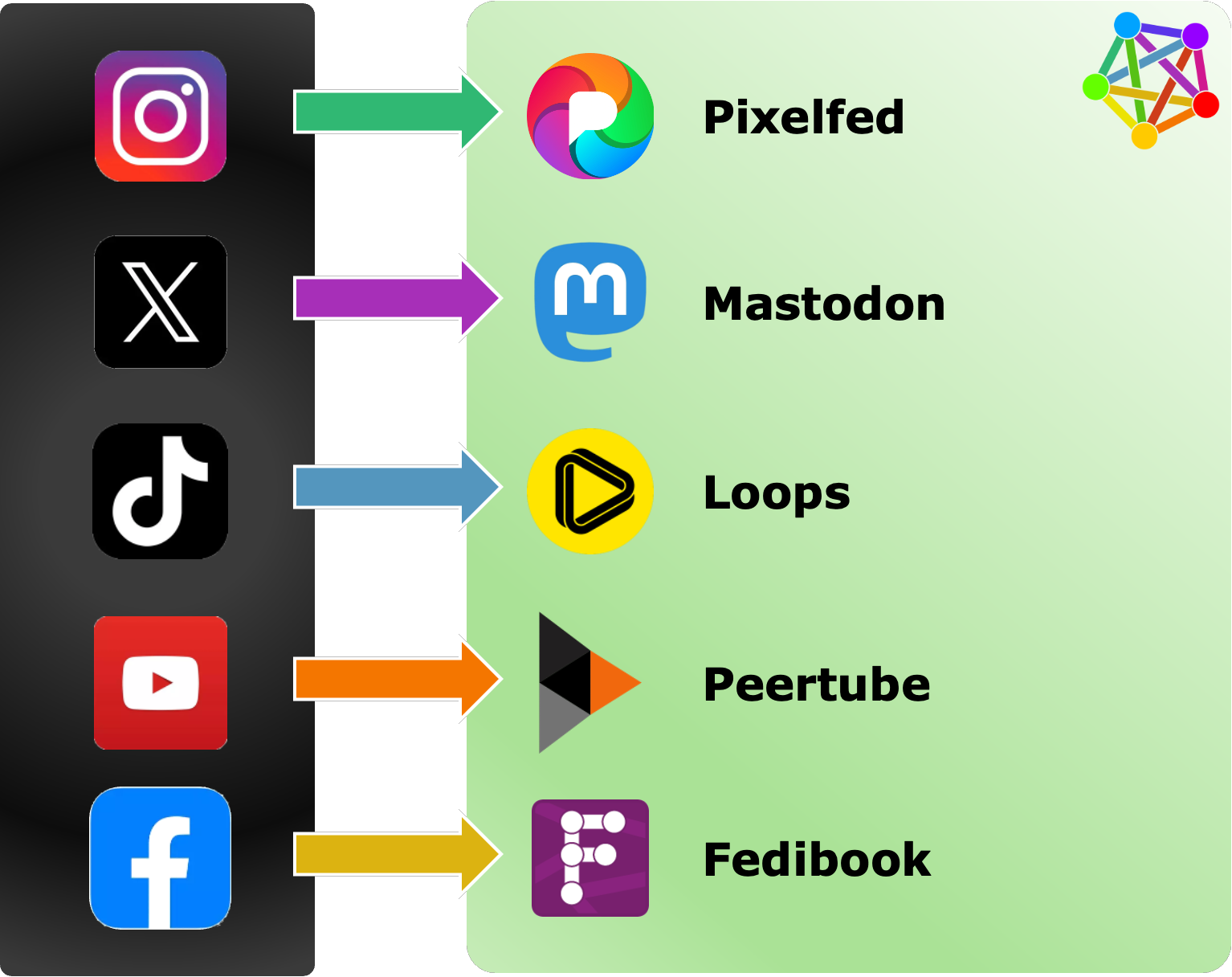
The Fedibook project is about identifying what is good about online community and leaving behind what is not. It is a rediscovery and a reinvention, and we will learn along the way.
If you want to be part of that journey, come join us. If you are a potential new user, create an account on the showcase instance at fedibook.net. If you are considering running your own Fedibook server — and I hope many will — jump in, install your own instance, and share your feedback on what it is like to be an operator.
If you cannot wait to bring all your friends to Fedibook but would rather not deal with things breaking or data being lost, I ask for a little more patience. Follow along at about.fedibook.net as the project evolves. If you are already on the Fediverse, follow the #fedibook tag.
Mission Statement
Fedibook's mission is to connect real-life friends and communities in a federated social network.
Design Goals
We want to rebuild the social network into something good. How good intentions become good design is the challenge, and we will learn and experiment as we build. Some of the objectives and goals are:
When you want — Fedibook is designed to be used on your own terms, when you decide to open it — like deciding to read the newspaper.
Inbox zero — We want you to know when you are up to date. No doom-scrolling, and a design that gives you a genuine sense of overview — like reaching the bottom of your inbox.
Friends and groups — The design focus is on Friends and Groups. Accessing the broader Fediverse through Follows and other future features must respect the core of what Fedibook is about: friends and community.
Project Promises
End to end — Fedibook connects willing speakers with willing listeners. No algorithm will ever filter or sort what you see or who you reach.
Part of the Fediverse — Fedibook is a connected and contributing part of the Fediverse. We will always work to embrace being a small part of something bigger, and will never introduce features designed to wall users in.
Your network — Fedibook will continue to develop as a product built for you and your friends. We will never spy on you, build a profile of your behaviour, or sell your data to anyone. What happens on your network stays on your network.
AI Assisted Development
Fedibook was built with significant help from AI — specifically Claude Code. This is not a secret. As a Product Owner, not a professional developer, with a clear vision but limited time, AI made it possible to build something that would otherwise have been out of reach. The architecture, the decisions, and the direction are human — the AI does a lot of the typing.
The code is open source and available for anyone to read and review.
Release Notes
To come.
Roadmap
There is no long or formal roadmap for Fedibook. As described, it will evolve as we work towards a better social network, so the roadmap is a loose to-do list to give an overview of what might come.
MVP release
The MVP release is a build-and-test process aimed at identifying a product that is good, likeable, and matches the mission. A successful prototype phase will lead to the first beta release — the first version of the software suitable for real users, where instance admins are able to perform proper housekeeping to ensure stable operation and ongoing upgrades. This will be the minimum viable product.
To-do list:
- Password change
- Invite friend
- Moderation: report post to group admin
- Moderation: terms of use page and acceptance flow
- Data export so users can move to a new instance
- ActivityPub "I moved" message
FAQ
Who is behind the Fedibook project!
The project was started by me, Rasmus Sindum, and I am currently the only developer. As the project evolves, my plan is to build a team around its development.
Why not just use Friendica?
Friendica is a genuinely impressive project and deserves a lot of respect. It is functionally one of the closest alternatives to Facebook in the Fediverse — it supports groups, events, and a familiar social graph, and it has been around for years.
That said, the design feels dated, and the interface can be difficult to navigate for users who are not already motivated to leave Facebook. Fedibook exists because I could not find something I felt confident putting in front of an ordinary Facebook user and saying: just try this. That is the gap Fedibook is trying to fill — not to replace Friendica, but to offer a different answer to the same problem.
Why can't I post to The World?
Why can I only post to my friends and groups — not to the wider Fediverse?
This is a deliberate design choice. Fedibook is built around Friends & Groups as its core value. Posting to the open Fediverse would require a very different approach to moderation — one that does not fit the current scope of the project.
What do you mean by moderation?
When you post publicly to the Fediverse, your content can reach anyone. That creates a responsibility to handle reports, abuse, and unwanted content at scale. Fedibook's model sidesteps this entirely: if a friend posts something inappropriate, you simply remove them as a friend. If a group member does the same, the group admin can remove them. The community moderates itself naturally through existing relationships — no dedicated moderation infrastructure required.
But I want to share something with the world. What should I do?
Use Mastodon. Seriously — it is built exactly for that. Mastodon is designed for public broadcasting to the open Fediverse, with mature tools for moderation, discovery, and reach. Fedibook and Mastodon complement each other rather than compete. Use each for what it does best.
And the good news: if you are already on Mastodon, your Fedibook friends can follow your Mastodon account and see your public posts in their World feed. The two work together.
Will Fedibook ever support posting to the world?
It cannot be ruled out. But with Friends & Groups as the heart of Fedibook, it is not a priority. Getting those core features right matters more than expanding scope prematurely.
Is Fedibook free? Forever?
The Fedibook software is free and open source, released under the GNU Affero General Public License v3.0 (AGPL-3.0) and available on Codeberg for anyone to download.
This does not mean that having an account on an instance is necessarily free. Servers cost money, and whoever chooses to operate a Fedibook instance sets their own terms. Most Fediverse servers are operated by volunteers and funded through sponsorships, and it is very likely that this will also be the case for most Fedibook instances. That said, there is nothing stopping someone from offering a professionally hosted service with a monthly subscription. Either way, remember that you are never paying with your data — unlike on Big Tech platforms.
Is there a mobile app?
Not yet, but it is on the roadmap. Fedibook is built as a web application, and the codebase is already structured in a way that would make a native app relatively straightforward to develop when the time comes.
In the meantime, Fedibook works well as a near-native app experience through your browser's Add to Home Screen (on mobile) or Install feature (on desktop). This saves Fedibook to your device and opens it in its own window without browser chrome — it looks and behaves much like a regular app, including on iOS, Android, and most desktop browsers.
Are my data private and secure?
The short answer is: it depends on who operates the instance you choose to use.
The Fedibook software itself is open source, which means the code can be read, reviewed, and audited by anyone. There are no hidden features, no tracking code baked in, and no back doors. What you see is what you get.
However, in a federated network, trust ultimately rests with the operator of your instance. Your data lives on their server, and they are responsible for how it is handled. If you choose an instance operated by an identifiable individual or organisation in a country where GDPR is taken seriously and enforced, you are in a reasonably good position. Look for instances that are transparent about who runs them, where they are hosted, and what their privacy policy says. The showcase instance at https://fedibook.net is operated by me, Rasmus Sindum, in Denmark.
That said, Fedibook is not designed for deeply confidential communication. Groups and posts are social by nature, and federation means your content may travel to other servers in the Fediverse. If you need a private, secure channel for sensitive conversations, we recommend looking at DeltaChat — a privacy-focused messenger that works over email and leaves no central server in the loop.