
The Fedibook project
Fedibook is a Friends First interface into the ActivityPub federated social network — also known as The Fediverse.
Fedibook aims to be the easiest way into the Fediverse, and familiar if you are coming from mainstream social media. That is why I call it Your Friendly Neighborhood Social Network.
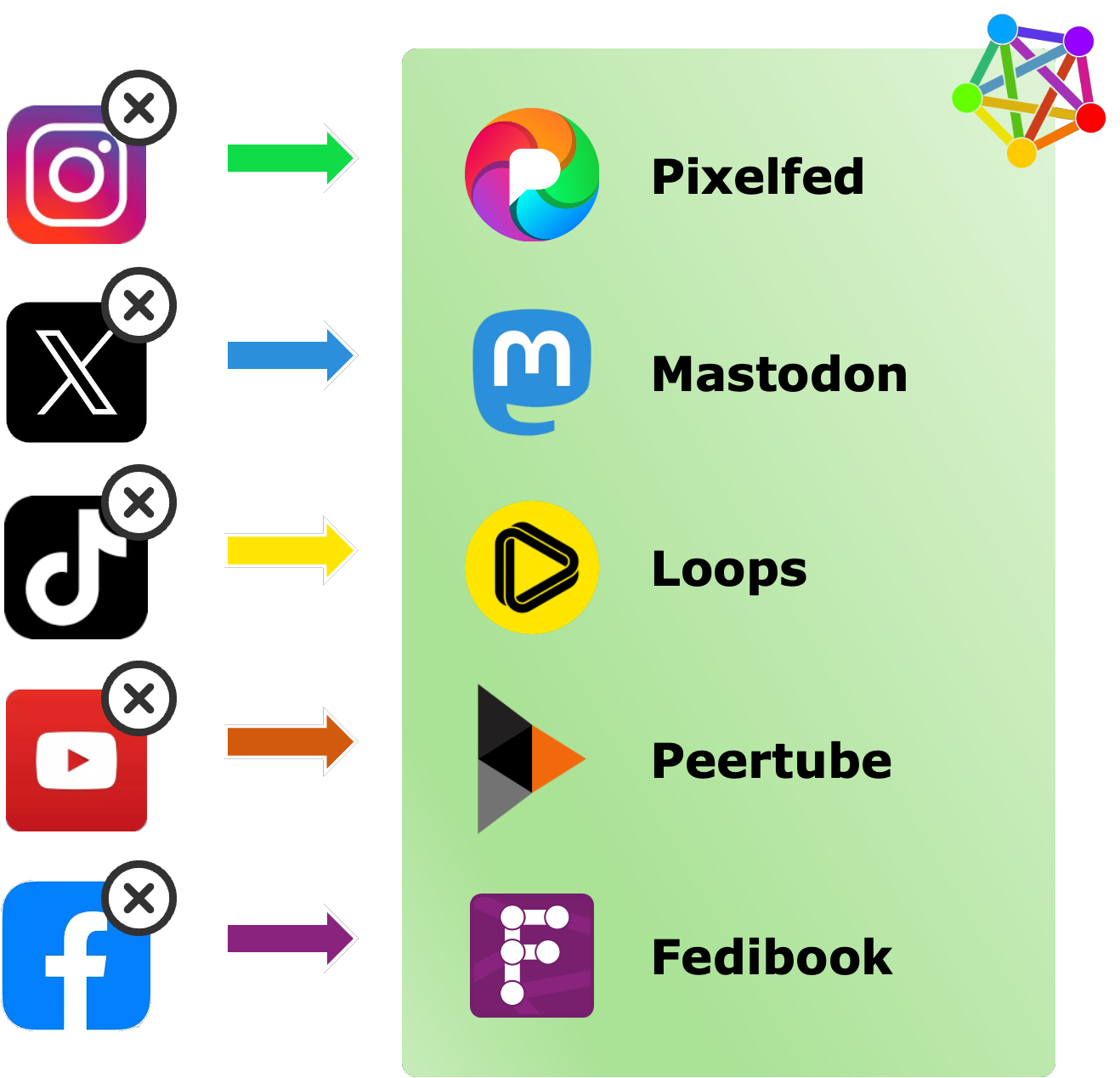
Fedibook is for you if you want to connect with friends and community groups. If you want to connect with people all over the world to discuss or learn about your favourite topics, Mastodon is likely the better option. If you want to see and share amazing pictures, go check out Pixelfed. If you are into short videos — whether for building a following or just enjoying a random scroll — go check out Loops.
Want to understand the Fediverse in 4 minutes? Watch the amazing video from Elena Rossini — a true hero of the Fediverse.
As you can see, there are great alternatives to the applications from Big Tech in the Fediverse. I hope Fedibook will be the last missing piece — the Friends First social platform the Fediverse has been waiting for.
The Fedibook project is about identifying what is good about online community and leaving behind what is not. It is a rediscovery and a reinvention, and I will learn along the way.
If you want to be part of that journey, come join. If you are a potential new user, create an account on the showcase instance at https://fedibook.net. If you are considering running your own Fedibook server — and I hope many will — jump in, install your own instance, and share your feedback on what it is like to be an operator.
Start using Fedibook with friends and communities who embrace the spirit of early-stage exploration.
If you cannot wait to bring all your friends to Fedibook but would rather not deal with things breaking or data being lost, I ask for a little more patience. Follow along at about.fedibook.net as the project evolves. If you are already on the Fediverse, follow the #fedibook tag.
Mission Statement
Fedibook's mission is to connect real-life friends and communities in a federated social network.
Design Goals
I want to rebuild the social network into something good. How good intentions become good design is the challenge, and I will learn and experiment as I build. Some of the core objectives are:
Friends and groups — The design focus is on Friends and Groups. Accessing the broader Fediverse through The World and other future features must always respect the core of what Fedibook is about: real connections between real people.
Inbox zero — The big platforms are designed to keep you scrolling forever — that is how they make money. Fedibook is built around the opposite idea: I want you to know when you are up to date. A genuine sense of completion — like reaching the bottom of your inbox. You open it, you see what your friends have been up to, and you close it knowing you have not missed anything. No infinite scroll. No algorithmic bait designed to hold your attention hostage.
When you want — Fedibook is designed to fit into your life on your own terms, when you decide to open it — like choosing to read the newspaper. Not the other way around.
Project Promises
End to end — Fedibook connects willing speakers with willing listeners. No algorithm will ever filter or sort what you see or who you reach.
Part of the Fediverse — Fedibook is a connected and contributing part of the Fediverse. I will always work to embrace being a small part of something bigger, and will never introduce features designed to wall users in.
Your network — Fedibook will continue to develop as a product built for you and your friends. I will never spy on you, build a profile of your behaviour, or sell your data to anyone. What happens on your network stays on your network.
Supporting The Fedibook Project
Sign up at https://fedibook.net, test the platform, and share your feedback. Join the @fedibook-grp@fedibook.net group to connect with others and say hi — you can join from Mastodon too, just find the group and follow it. Your input helps shape the project.
Subscribe to about.fedibook.net to stay updated and follow the project as it evolves.
Run your own server and operate it for your community — that is what the Fediverse is all about. Fedibook's goal is to foster a network of committed instance communities, each shaping their own space while staying connected. If you are ready to take the leap, spin up your own instance and be part of building a decentralised, community-driven social network. A Docker host with 2–4 GB RAM is all you need to get started.
FAQ
Who is behind the Fedibook project?
The project was started by me, Rasmus Sindum, and I am currently the only developer. As the project evolves, my plan is to build a community of contributors around it.
Why not just use Friendica?
Friendica is a genuinely impressive project and deserves a lot of respect. It is functionally one of the closest alternatives to Facebook in the Fediverse — it supports groups, events, and a familiar social graph, and it has been around for years.
That said, the design feels dated, and the interface can be difficult to navigate for users who are not already motivated to leave Facebook. Fedibook exists because I could not find something I felt confident putting in front of an ordinary Facebook user and saying: just try this. That is the gap Fedibook is trying to fill — not to replace Friendica, but to offer a different answer to the same problem.
Why can't I post to The World?
This is a deliberate design choice. Fedibook is built around Friends & Groups as its core value. Posting publicly to the open Fediverse would require a very different approach to moderation — one that does not fit the current scope of the project.
When you post publicly, your content can reach anyone. That creates a responsibility to handle reports, abuse, and unwanted content at scale. Fedibook's model sidesteps this entirely: if a friend posts something inappropriate, you remove them as a friend. If a group member does the same, the group admin removes them. The community moderates itself naturally through existing relationships — no dedicated moderation infrastructure required.
If you want to share something with the world, use Mastodon. It is built exactly for that — public broadcasting to the open Fediverse, with mature tools for moderation, discovery, and reach. Fedibook and Mastodon complement each other rather than compete. And if you are already on Mastodon, your Fedibook friends can follow your Mastodon account and see your public posts in their World feed.
Will Fedibook ever support posting to the world? It cannot be ruled out. But with Friends & Groups as the heart of Fedibook, it is not a priority right now.
Is Fedibook free? Forever?
The Fedibook software is free and open source, released under the GNU Affero General Public License v3.0 (AGPL-3.0) and available on Codeberg for anyone to download.
This does not mean that having an account on an instance is necessarily free. Servers cost money, and whoever operates a Fedibook instance sets their own terms. Most Fediverse servers are run by volunteers and funded through community support — it is very likely that most Fedibook instances will follow the same model. Either way, you are never paying with your data, unlike on Big Tech platforms.
Is there a mobile app?
Not in an app store. Instead, Fedibook is built as a Progressive Web App (PWA), so you can install it directly from your browser for a near-native app experience — no app store required.
On Android, open Fedibook in Chrome and tap "Install" or "Add to Home Screen" to save it to your device. It launches in its own window without browser clutter, just like a regular app.
On iPhone, add Fedibook to your home screen from Safari. It will open in full-screen mode when launched from your home screen.
Fedibook supports Web Push notifications, so you will receive real-time alerts for messages, group activity, and updates — just like a native app — without needing to keep your browser open.
A native app is planned for the future, but the PWA already provides a smooth, app-like experience today.
Are my data private and secure?
The short answer is: it depends on who operates the instance you choose to use.
The Fedibook software is open source — the code can be read, reviewed, and audited by anyone. There are no hidden features, no tracking code, and no back doors.
In a federated network, trust ultimately rests with the operator of your instance. Your data lives on their server. If you choose an instance run by an identifiable person or organisation in a country where GDPR is enforced, you are in a reasonably good position. The showcase instance at https://fedibook.net is operated by me, Rasmus Sindum, in Denmark.
Fedibook is not designed for deeply confidential communication. Groups and posts are social by nature, and federation means your content may travel to other servers in the Fediverse. If you need a private, secure channel for sensitive conversations, I recommend looking at DeltaChat — a privacy-focused messenger that works over email and leaves no central server in the loop.
Was Fedibook built with AI?
Yes. Fedibook was built with significant assistance from AI — specifically Claude Code. This is not something I have kept hidden; it is a deliberate choice I have been open about from the start.
I am a Product Owner, not a professional developer. Building Fedibook from scratch on my own would have been out of reach without AI assistance. Claude Code made it possible. The architecture, decisions, and overall direction are mine — the AI primarily helps with the actual coding.
The code is open source and available on Codeberg for anyone to read, review, and scrutinise. Like all code, it should be read critically, tested, and improved. That is the purpose of open source.
Fedibook itself does not contain AI. There are no algorithmic feeds, AI-generated content, or machine learning involved. It is a straightforward social network built by a human with the help of an AI assistant.
I understand and respect the pushback against AI-assisted development — concerns about quality, job displacement, and accountability are valid. My response is transparency and open source: the code is there for anyone to examine, challenge, and improve.
I am not an AI fanboy. I often worry deeply about what it is doing to our world. But it is here. I would rather use it to build something open and honest than leave that space to Big Tech.